

Key Takeaways
- AI, automation, and supply chain planning only work when data is unified, accurate, and accessible across the business.
- From cost spikes to tariff changes to supplier disruptions, real‑time insight drives better decision‑making and reduces operational risk.
- ERP, MES, and other core platforms must be modernized, connected, and governed well before advanced technology can deliver meaningful ROI.
Manufacturers are entering 2026 focused on growth, operational efficiency, and modernization. According to our recent survey results:
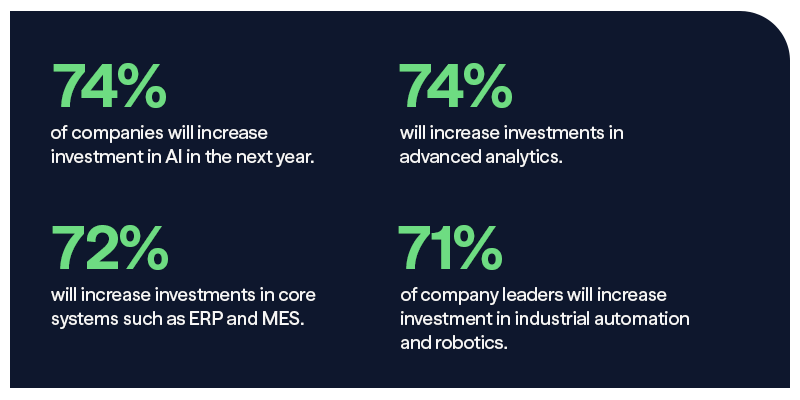
But with rising costs, supply chain volatility, and a rapid push toward automation and AI, the real differentiator isn’t equipment, software, or even talent. It’s data — specifically, data that is connected, clean, and accessible across the business.
Integrated data is the foundation for every strategic initiative manufacturers are prioritizing this year. Without it, progress stalls before it starts.
Here’s how to shift from reactive decisions to proactive planning, with data you can actually use.
Why Integrated Data Matters Now
AI Only Works When Data Works
AI adoption is accelerating. Three‑quarters of mid‑market manufacturers plan to increase AI investment this year, with quality inspection, inventory optimization, and process efficiency as their top priorities. But there’s a catch: AI is only as strong as the data feeding it.
Many companies say their systems are becoming more AI‑ready, yet disconnected machines, inconsistent reporting, and outdated spreadsheets still limit the accuracy and usefulness of AI models. If you want AI to deliver real operational value — fewer defects, faster cycle times, stronger forecasting — you need unified, trustworthy data behind it.
Automation Depends on Real-Time Insight
Manufacturers continue to ramp up investment in automation and robotics. But automation is most effective when it’s fueled by shared, consistent data that flows across ERP, MES, production lines, and quality systems.
Integrated data supports:
- Predictive maintenance
- Scrap rate anomaly detection
- Downtime reduction
- Workforce allocation and scheduling
Automation without connected data just accelerates already broken processes.
Supply Chain Volatility Won’t Slow Down
Transportation costs, supplier delays, changing regulations, and tariff exposure continue to reshape global operations. More companies are reshoring or nearshoring, expanding supplier networks, and adopting AI and scenario modeling to manage risk.
All of these strategies rely on the same thing: accurate, real-time supply chain data.
When data lives in silos, your teams react to problems instead of anticipating them. Integrated data enables what manufacturers need most this year — clarity, speed, and better cost control.
The Problem: When Data Lives in Silos, Strategy Stalls
Many manufacturers still rely on manual reporting, legacy systems, or disjointed tools that don’t communicate. Data might live across an ERP, warehouse management system (WMS), sales software, and spreadsheets. Each piece of the puzzle offers a partial picture, but no single source reveals what’s really happening.
This creates several risks:
- Missed reorders or stockouts due to poor inventory visibility
- Vendor relationships based on anecdote, not performance
- Sales prioritization without understanding customer value or churn risk
- Pricing strategies that don’t reflect true margins or costs
When data isn’t integrated, teams spend more time reconciling numbers than improving operations.
The Shift: Moving from Reports to Real-Time Intelligence
One client came to us with this exact challenge: their operations team had data, but no clarity. We helped them build a unified Manufacturing Analytics 360 environment that connected their ERP, WMS, and production data into a centralized data warehouse. Manual reporting that once took hours each week was replaced by automated information flow. This allowed leaders to focus on high-value decisions based on real-time insights they could trust.
Here’s what integrated data makes possible:
1. Real-Time Decision-Making
Manufacturers feel more confident when they can see what’s happening across operations in real time. Integrated data gives leadership a single view of production, quality, financials, and supply chain performance, so they can adjust quickly when conditions change.
2. AI That Delivers Results
With unified data, AI can identify patterns, spot risks earlier, automate repetitive tasks, and help teams focus on higher‑value work. Integrated data turns AI from a buzzword into a true performance driver.
3. Stronger Supply Chain Modeling
Integrated data enables better scenario planning, supplier evaluation, tariff modeling, and cost forecasting. With visibility across the full supply chain, manufacturers can make smarter sourcing decisions and reduce risk.
4. Better Financial and Operational Performance
Operational data becomes more accurate. Financial planning becomes more reliable. Production workflows become more predictable. Vendors become easier to evaluate. And teams spend less time digging through spreadsheets and more time solving problems.
The Opportunity: Build an Integrated Data Strategy That Works
True modernization isn’t just about buying new software. It’s about building an ecosystem that supports how your business runs. Start with the building blocks that make the biggest difference:
Upgrade and connect your core systems.
Many companies are increasing investments in ERP and MES this year — and for good reason. These systems are the backbone of operational data. Modernizing them first creates a strong foundation for AI and automation.
Establish a clear data governance framework.
Define owners, rules, and processes for how data is captured, validated, and maintained. This ensures consistent, trustworthy data across the business.
Identify your highest‑value use cases.
Whether it’s quality inspection, predictive maintenance, or inventory optimization, choose one area where integrated data will have immediate impact. Prove value early and expand from there.
Connect operational, financial, and supply chain data sources.
True integration means systems talk to each other. This allows teams from the plant floor to procurement to finance to work with the same information.
Build dashboards that show what matters most.
Decision‑makers shouldn’t hunt for critical metrics. Create real-time dashboards that align to your goals and give teams proactive visibility.
Move from Guesswork to Meaningful Growth
Manufacturers who invest in integrated data today will outpace their competitors tomorrow. When your data is connected, everything else becomes easier: AI adoption, automation, supply chain resilience, forecasting, and strategic decision‑making.
Let’s explore how an analytics-first strategy can help you improve performance and build lasting resilience, no matter what the market brings.
Contact Eide Bailly Manufacturing Advisors | Access the 2026 Manufacturing Outlook Report
Frequently Asked Questions
Why is integrated data so critical for manufacturers in 2026?
Manufacturers are investing heavily in AI, automation, and supply chain optimization. All of these depend on clean, connected data. Without it, decisions are slower, forecasting is less accurate, and technology investments underperform.
How does integrated data support AI adoption?
AI models rely on consistent, high‑quality data. When data is fragmented across systems or captured inconsistently, AI outputs become unreliable. Integrated data ensures AI can identify patterns, reduce defects, streamline processes, and support predictive insights.
How should manufacturers start building an integrated data strategy?
Begin by modernizing and connecting core systems like ERP and MES. Establish data governance, define ownership, and unify the most critical data sources first — production, quality, supply chain, and financials.
Why choose Eide Bailly for your manufacturing needs?
Eide Bailly helps manufacturers work smarter — financially, operationally, and strategically. With over 100 years of experience and thousands of manufacturing clients served, we deliver audit, tax, technology, and advisory solutions that optimize supply chains, improve efficiency, and enable digital transformation. Our team combines industry insight with innovative tools to help manufacturers reduce risk, enhance performance, and grow with confidence.
2026 Mid-Market Manufacturing Outlook Report

Manufacturing, Distribution, and Logistics
Rely on the trusted expertise of manufacturing advisors to help you build and execute your strategic vision.
Who We Are
Eide Bailly is a CPA firm bringing practical expertise in tax, audit, and advisory to help you perform, protect, and prosper with confidence.
